Knight Lorem
My version of Knight Lore, a game I've wanted to remake for a long time, made of point clouds
Play itI've wanted to remake Knight Lore for a long time. It's a ZX Spectrum game from 1984, and it was a really important game to me growing up.
A few days ago I finally made my own version. It's called Knight Lorem, and that's it playing above: an isometric castle where you turn into a wolf every night. There isn't a single polygon or sprite in it - everything you see is a point cloud. It runs in the browser, on a computer or a phone, so you can play it right now.
Where the idea came from
A few days ago I saw this post by Silicon Jungle: 3D scenes that look like hand-drawn pixel art, generated with Fable 5.2.
I've worked with point clouds and volumetric video before, but I had never seen them look like this. I wanted to try it right away, and I already knew what I was going to build with it.
Splats or point clouds?
Silicon Jungle calls these pixel art gaussian splats, and I honestly don't know if that's also the right name for what Knight Lorem does.
To me Knight Lorem's version is more like a point cloud: a few hundred thousand points sitting on the surface of things. So that's what I'm going to call it here.
How Knight Lorem works
There are three steps.
Step 1: describe everything with math
Every object in the game is a formula that takes a point in space and answers one question: how far is this point from my surface? That's called a signed distance function.
A ball is one formula and a capsule is another. Blend a few of them together and you get more complicated shapes.

Everything is built this way: the walls, the cauldron, the enemies, the wolf. There's no modeling software involved.
Step 2: throw flour at it
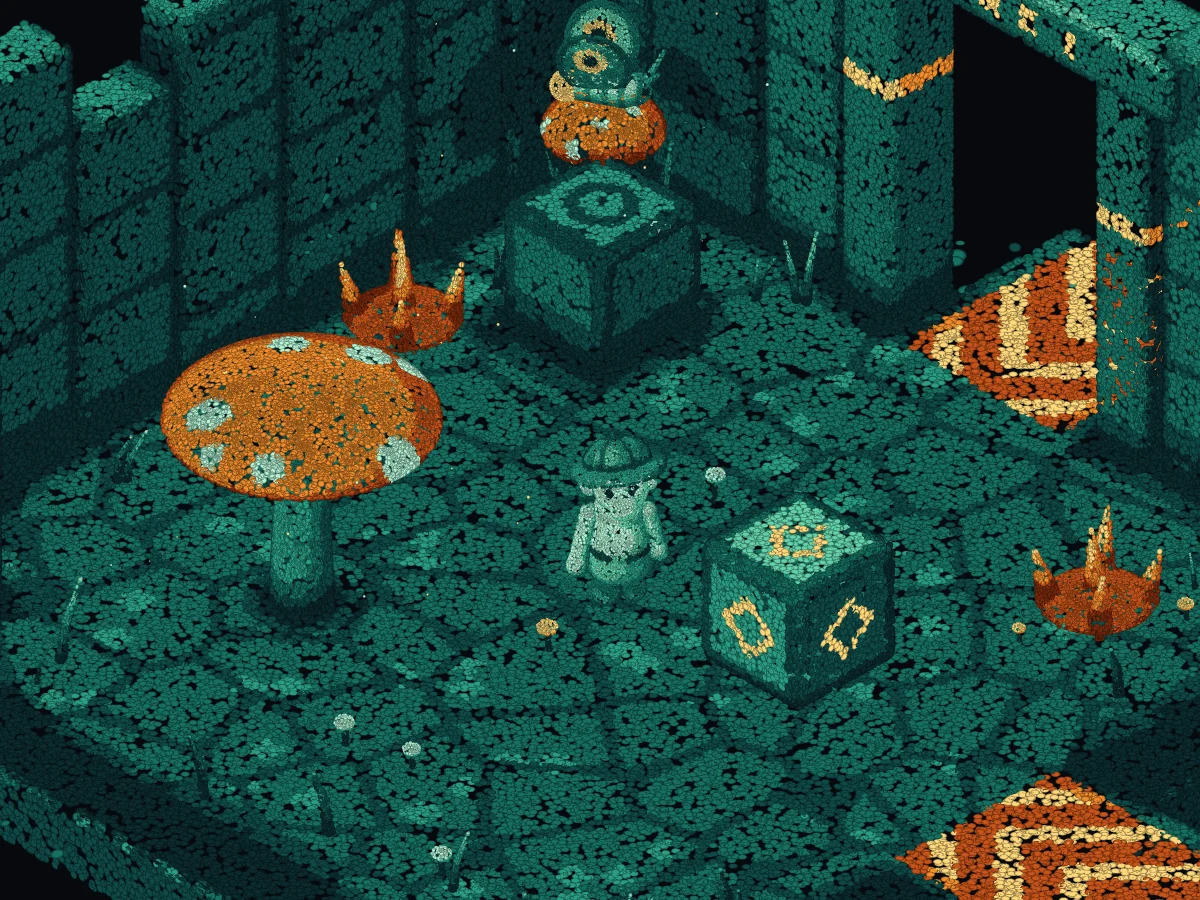
You can't see a formula. So the game scatters points all over the surface each formula describes, kinda like finding out the shape of a ghost by throwing flour at it.
Each point remembers where it is, which way the surface is facing, and what it's made of. A room takes about 250 thousand of them.
Step 3: take a really bad photo
This is the part that makes it look like pixel art:
- The scene is drawn at a very low resolution.
- Every pixel has to pick a color from a small palette.
- Dithering fills in the shades in between. That's the checkerboard pattern old games used to fake having more colors.
- Dark outlines are drawn where one object ends and another begins.
- The result is scaled back up with no smoothing.
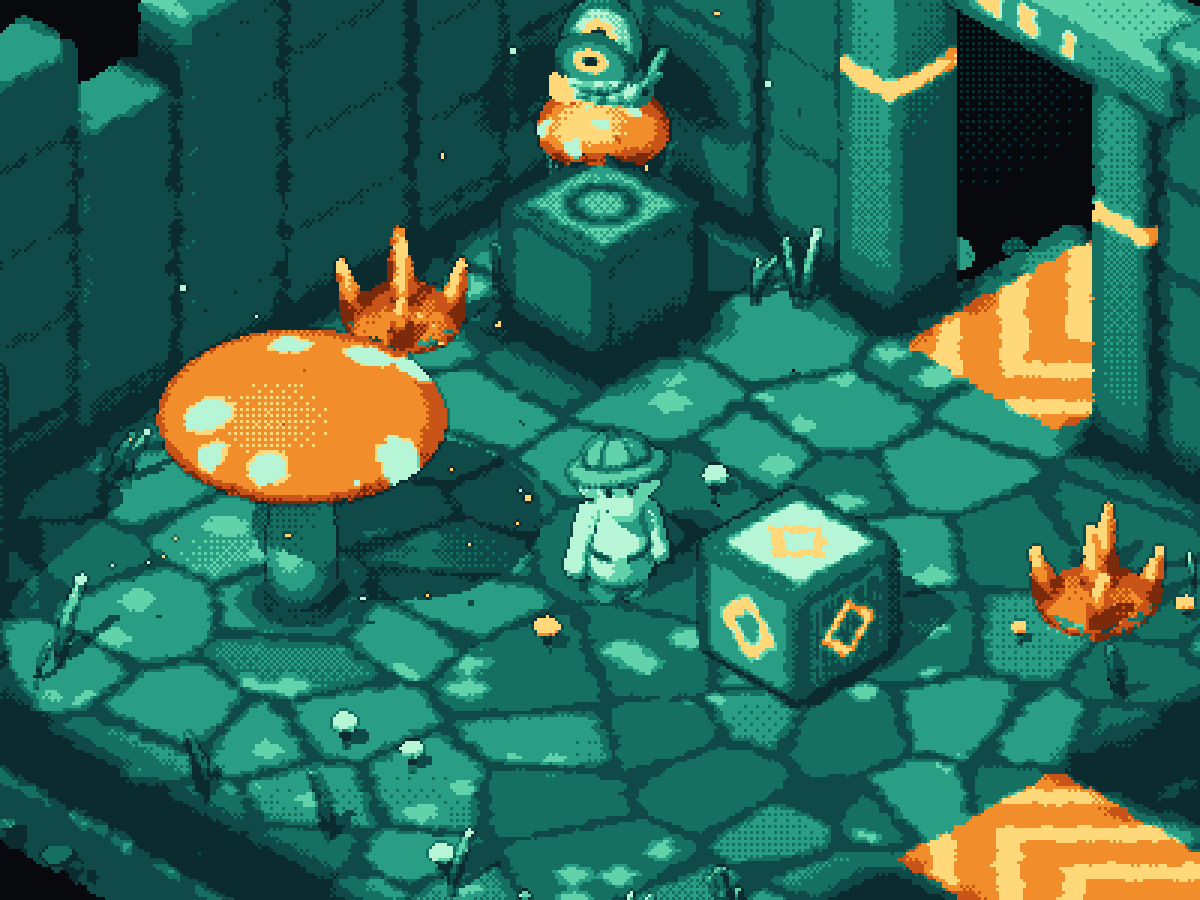
So basically it's a 3D renderer with the world's worst camera pointed at it.
What you get for free
Since everything is a cloud of points, nothing has to be a rigid object.
When you walk through a door, the next room grows in as a wave of points. When night falls, a line sweeps up the character and what it leaves behind is a wolf. With triangles each of these would be a lot of work. With points you pretty much just tell them to go somewhere else.
The game I wanted to remake
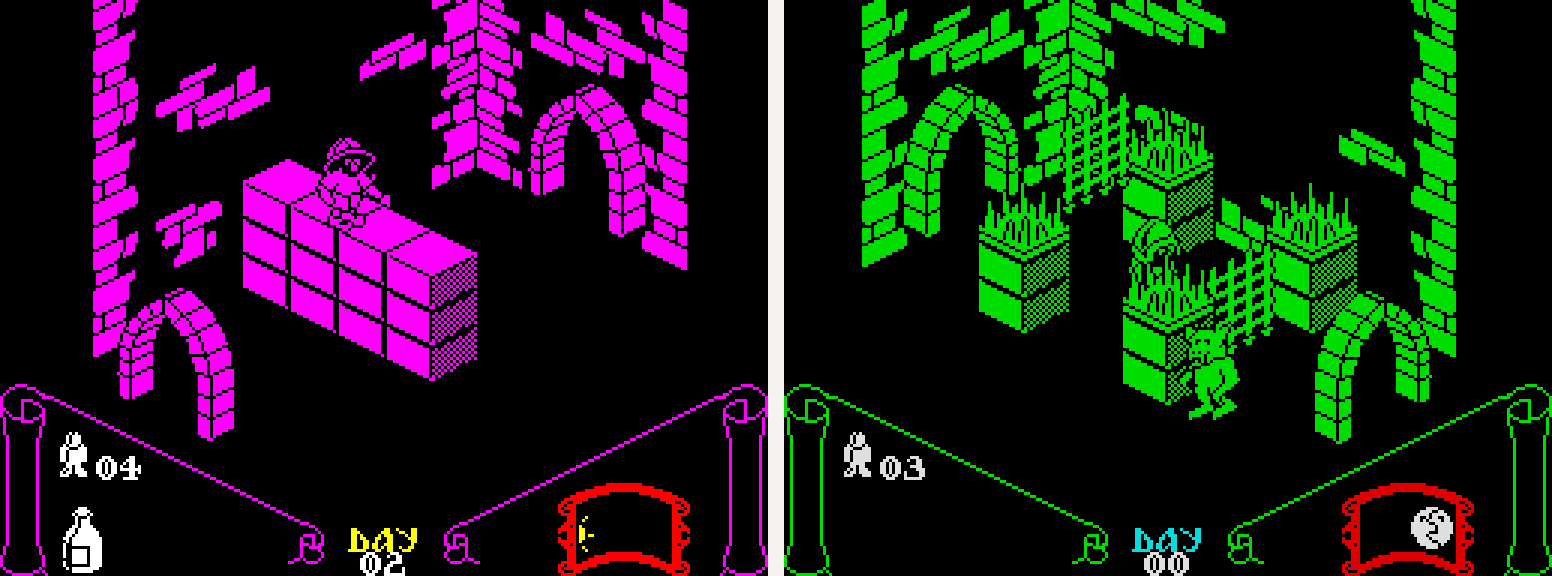
When I was a kid, my brother used to play Knight Lore on a Brazilian clone of the ZX Spectrum.
Knight Lore came out in 1984, made by Ultimate Play the Game (they later became Rare, the Donkey Kong Country people). You play Sabreman, who is cursed to turn into a werewolf every night. He has 40 days to bring a wizard's cauldron everything it asks for, or the curse becomes permanent.
All of that in isometric 3D, on a computer with 48K of memory. For reference, the short clip at the top of this post is about 24 times that.
I was around 10, a tiny kid with chopstick legs, and to me it was one of the coolest games ever.
Then one day Rogério, a friend of my brother's, ported it to the MSX right in front of my eyes. Rogério was skinny and had long hair and huge glasses, pretty much Hackerman from Kung Fury. I remember watching him edit assembly code and thinking: this is the coolest dude in existence, and this is what I want to do when I grow up.
This was around 1994. Every other kid in Brazil wanted to be Romário, and my hero was a guy with huge glasses typing assembly. No wonder girls didn't come near me much.
I never saw Rogério again, and I still have no idea how he did it.
Years later, when I started university, I wanted to get into making games. At the time I was more interested in 3D and whatever technology was new. But eventually the nostalgia got to me, and I wanted to go back and revisit those very old games. That's when I started wanting to remake Knight Lore.
I tried a few times over the years and never got too far, because Capitalism. There was always something more important to do.
So when I saw Silicon Jungle's technique a few days ago I was like: FINALLY.
Fable refused to build a clone
What changed is that now, if you explain nicely to a computer what you want, the computer does the hard part for you and you're left with only the easy fun part. I'll confess I do miss some of the hard fun part. But as I already said, Capitalism.
So I didn't type most of the code for this. I built it with Fable 5.2, and the first thing I asked for was simple: remake Knight Lore using this technique.
It refused. It said it wouldn't recreate an existing game, but it could make an original one in the same genre.
So instead of getting a clone in one shot, I had to ask for things one at a time:
- Bigger rooms, and enemies in them.
- A day and night cycle, with the wolf.
- A cauldron in the middle of the castle that shows what it wants next.
- Blocks you can push and climb.
- Walls you can only get over by stacking the things you're carrying.
- Gates that drop from the ceiling.
For each one I had to work out what I wanted, play what came out, and send it back when it felt off. The wolf transformation alone took a few rounds.
We ended up with almost a clone anyway, hehe. Not really though - it's more of a reinterpretation than a port. Kinda like a cover song.
I think the refusal did me a favor though. If Fable had built Knight Lore on the first try, I probably would've been happy with whatever came out, and I wouldn't have had any input over the whole thing. Because it said no, everything in the game is there because I asked for it, and most of it took a couple of rounds to get right.
I've been saying for a while that taste matters more than technical chops now, and this was a pretty good example. I don't fully understand how this renderer works. But I knew what I wanted it to look like, and I could tell when it wasn't there yet.
A few things about this one
- The castle is a 5x5 grid of rooms with the cauldron in the middle. It wants 14 things, and you have 40 days.
- As a wolf you're faster and you jump higher. But the thing that guards the cauldron can't stand wolves and will throw you across the room, so deliveries are a daytime job.
- The game starts with a fake tape loading glitch, because Spectrum games came on cassette tapes and took minutes to load.
So I ended up pretty much where I was at 10: watching someone else make this game right in front of my eyes, and only kinda understanding how they did it.
---
Play Knight Lorem. And go follow Silicon Jungle.